“Truth is found in simplicity, not in the multiplicity and confusion of things.”
-Issac Newton
“Everything should be made as simple as possible but not simpler.”
-Einstein
Since Aristotle took the first step towards understanding the complexities and mechanics of this world, various scholars have engaged in understanding, truly, what the universe carries in its embracing hold. Based on the principles of Reductionism and Unification, physics attempts to consolidate various physical phenomena through concepts and laws to unite all fundamental forces in nature under a single equation, to capture a solitary picture that can explain all that happens in our bizarre universe.
Currently, such an equation hasn’t been framed, but there is one theory that comes close — ‘The Standard Model’.

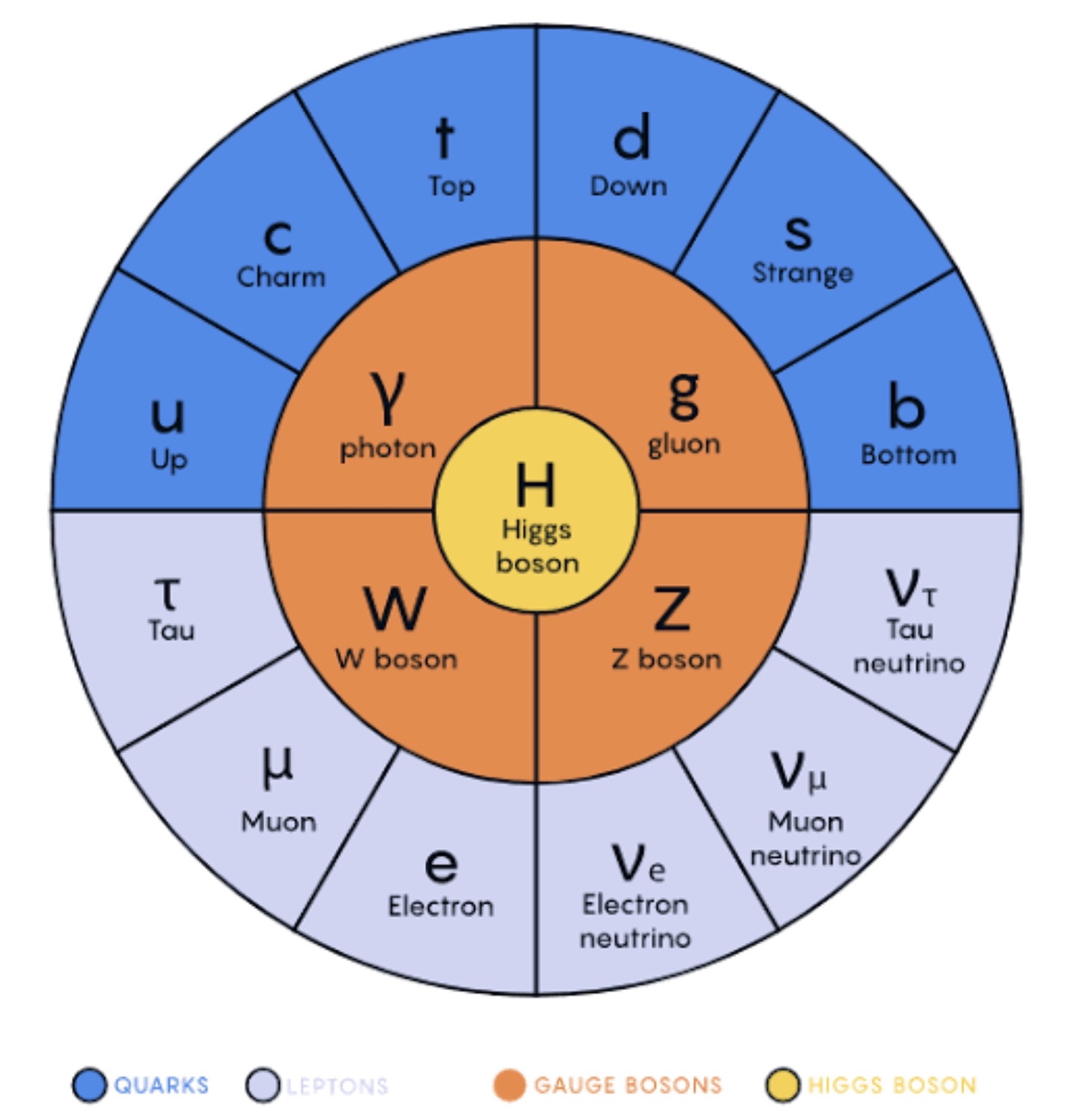
It interprets the universe as a culmination of various combinations of 12 particles and most of the fundamental forces, apart from gravity, and shows how they are bound together by a fascinating particle called the Higgs Boson. One of the main reasons gravity hasn’t been acquainted with this equation is due to the lack of knowledge on how to combine classic and quantum theories.
The existing model comes from quantum theory which states the nature of matter both as a particle and a wave. Various particles of matter combine in varied patterns to create our world.

All particles of matter are called Fermions and those of force is called Bosons. The fermions are the building blocks of matter, they space out and keep apart while the Bosons act as glue. Some of these particles are rare to see as they decay as soon as they form; their discovery should be credited to the advancement of technology that gave us particle accelerators. The 12 particles can be reduced to 4 primary particles which are electrons, the up and down quark. The quarks combine in 2:1 ratios to form the nucleons, later joining with electrons to form an atom. The 4th particle, also known as the ‘Ghost particle’, tends to remain as far from interactions as possible and is called the Neutrino.
The remaining particles are variations of these 4 main particles, displaying similar properties like these elements but varying in mass. The second generation of particles contains muons, the strange quark, the charm quark and muon neutrinos. The third generation involves the Tau, Top quark, Bottom quark and the Tau neutrino. They can be described all together through the Dirac equation.

The force particles,i.e, Bosons present on the standard model are particles of electromagnetism, strong and weak force. These bosons move between fermions to give rise to different types of forces. Another particle included in the 2nd layer is the particle of light called the photon.
Lastly, the most complex of all particles in this model, the Higgs Boson, plays the most important and complex role by endowing all these particles with a mass which determines their change and speed and positions when it encounters any force.
Even though there are some phenomena of the universe that are absent in this equation, the Standard Model has helped us take yet another big step towards discovering a theory that would be able to decipher the biggest riddles of our universe.
 Through my eyes