BLOOM’S TAXONOMY
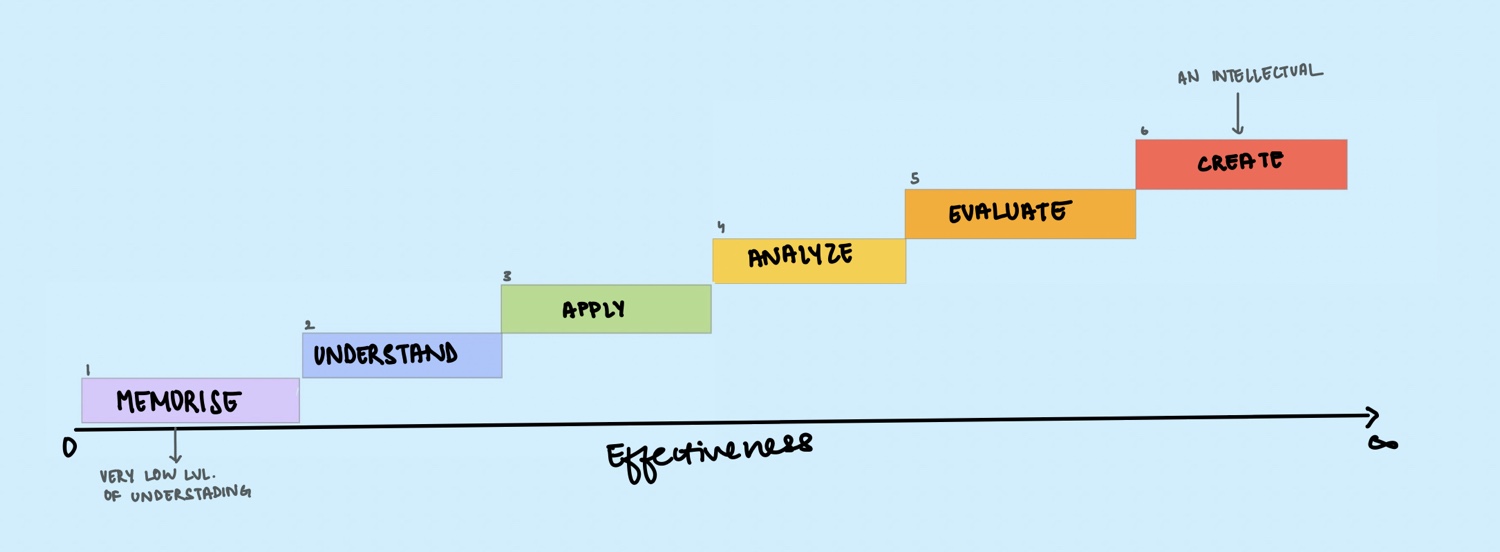
- 1. Memorizing: Being able to recall species about a subject such as methods, processes, patterns, structures, settings etc.
- 2. Comprehending: Being able to understand the knowledge such that you can teach it or explain it to someone else.
- 3. Applying: Being able to use information learnt in concrete situations.
- 4. Analyzing: Being able to pluck apart information and relate it to other topics, and make relations between several parts of the content on a larger scale.
- 5. Evaluating: Being able to critique and pass judgement on information and it’s value.
- 6. Contributing: Being able to push the boundaries of human knowledge by discovering new ideas and concepts about a topic.
Out of all the methods of consuming information, the most efficient ones are towards the higher end, i.e, 4, 5 & 6. Those of the least efficiency lie at the bottom, i.e, 1,2 and they are also the methods most of us use while studying.
Much research shows that applying and evaluating content makes the information stick and helps us understand more when compared to spoon-feeding the information to yourself at hours without an end.
Why should we use Bloom’s taxonomy?
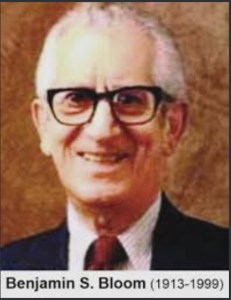
Bloom’s Taxonomy was named after the psychologist Benjamin Bloom, who along with his team of members researched several factors and what impact they had on learning.
Since Bloom’s Taxonomy pushes us to use higher cognitive thinking, it tends to further our understanding of content via problem-solving, evaluation and deliberation.
What are it’s implications of the education system?
Bloom’s Taxonomy has been the base of many philosophies that involve application of knowledge. It emphasizes critical thinking and exercising our understanding and our ability to grasp information to engage ourselves more with the content. For example, solving HOT’s questions is a tactic used in textbooks to check our capacity to apply our learnings.
Is it a suitable method for all?
Similar to most studying methods, the efficiency of Bloom’s Taxonomy as a method of teaching varies from person to person. It highlights the importance of higher-level learning and makes the lower levels seem inefficient or unnecessary. But, in some fields such as forensic sciences, mechanical engineering, medical sciences, etc…. the lower levels of learning such as memorizing play an important role.
Bloom’s method emphasises the application of knowledge and promotes a deeper understanding of a concept as a method of learning before introducing the concepts to the student. But this method is more inclined to support fields that depend more on problem moving such as Research, Law enforcement, Business, etc.
 Through my eyes